

The sticky-note offer map
Untangle a messy offer in 30 minutes with three colours of sticky notes, a blank wall and the method we use at the start of every strategy sprint.
 Leo HartDesign lead
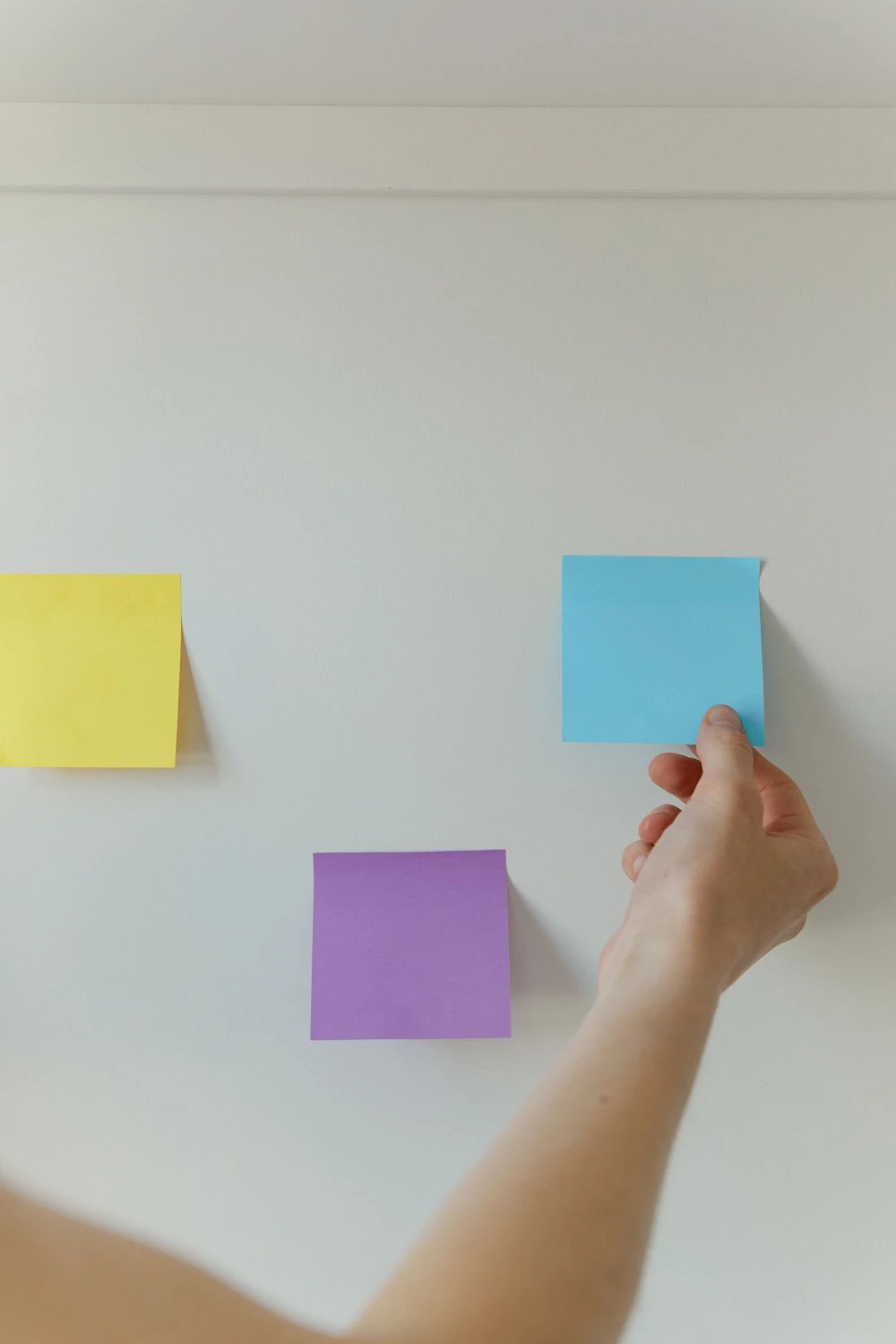
Most founders can't explain their offer in a sentence, and it isn't because they're unclear. It's because their offer has grown over the years. A package here, an add-on there, a service a client once asked for that never quite left. Eventually even you don't know what you're selling.
The sticky-note offer map is the fastest fix I know. It needs three colours of notes, a blank wall and about 30 minutes. We use it with clients at the start of every strategy sprint, and it works just as well on your own.
Why a wall beats a document
A document hides its mess in paragraphs. A wall shows everything at once. When every service is a physical note, you can see duplicates, spot the gaps and move things around without rewriting. Your brain handles shapes and colour far better than long lists.
It also lowers the stakes. A sticky note is cheap and easy to remove, so you stop protecting ideas and start judging them.
What you need
- Three colours of sticky notes. Any three, as long as you remember what they mean.
- A marker, so that you write short and large.
- A clear wall or a big sheet of paper.
- A timer set to 30 minutes.
The 30-minute method
Minutes 0 to 10: Everything you sell (yellow)
Write every product, service and package on yellow notes, one per note. Include the small things, such as the one-off call or the template you share for free. Don't judge or edit. Put them all on the wall.
Minutes 10 to 15: Who it's for (pink)
For each yellow note, write the person who buys it on a pink note and stick it underneath. Be specific. “Small business owners” is too wide. “A florist with two staff who wants more weddings” is right.
You will soon see patterns. Some yellow notes have no pink note at all, and some pink notes belong to three different offers.
Minutes 15 to 25: The result (green)
Next to each pair, add a green note with the result the customer gets. Write it as an outcome, not a task. “A brand kit” is a task. “A look you're proud to send people to” is an outcome.
Minutes 25 to 30: Cut, merge, rename
Now take a step back and work through the wall:
- Cut any yellow note with no clear pink and green. It's a hobby, not an offer.
- Merge offers that serve the same person with the same result.
- Rename anything that needs a paragraph to explain.
- Circle the three that earn the most or that you enjoy the most.
“If you can't put your offer on three notes, you can't put it in a customer's head.” Leo Hart, design lead
What to do with the map
Take a photo before you move anything. Then write one line for each of your remaining offers, using this format: I help [pink] get [green] with [yellow]. That sentence is the start of your messaging, and it's what goes on your homepage.
Common patterns
- The bloated menu. Fifteen yellow notes, four pinks. Merge and tidy until you have three or four offers.
- The invisible star. A small service your customers love and you barely mention. Move it to the front.
- The wrong customer. A good offer aimed at the wrong person. Rewrite the pink, not the offer.
A worked example
Last spring a ceramics studio came to us with eleven yellow notes: mugs, plates, bespoke wedding sets, workshops, gift cards, a subscription, a wholesale range and four things they were embarrassed to admit they'd stopped making. Their pink notes were mostly “anyone who likes pottery”.
Within twenty minutes the wall showed something different. Workshops and wedding sets were attached to specific people with clear results, and the rest was noise. They cut six offers, merged two and renamed the rest. Three months later, bookings for the two surviving offers were up 60 percent, mostly because customers finally understood what to ask for.
What to watch out for
The map is simple, so it's easy to cheat. Three habits keep it honest.
- Write what you really sell today, not what you wish you sold. The aspirational offer belongs on a separate wall.
- Don't skip the pink notes. An offer with no named buyer is the most common reason a product stays invisible.
- Resist the urge to keep everything. Each note you cut makes the remaining ones easier to explain and easier to sell.
Questions we hear
What if I only sell one thing?
Do it anyway, using the notes for versions of that offer. A single service sold to three different people usually reveals which customer you should focus on.
Can I do it with my team?
Yes, and you should. Give everyone a marker and ask them to write notes without discussing. The gap between what you think you sell and what your team thinks you sell is often the most useful part.
Does it work digitally?
A whiteboard tool works, but physical notes make you slower and more decisive. If you must go digital, keep the same three colours and the same time limit.
Run it again every quarter
Offers drift. Set a calendar reminder to rebuild the map every three months. It takes half an hour and usually removes one note you were quietly dreading.
Grab a pad, clear a wall and start the timer. You'll know by minute 25 what to keep, and the clarity tends to show up in your sales soon afterwards.
More on showing up.
Three more reads that pair well with this week's calendar.
All articles


Comments 04
Be kind. Ama reads every one.This is the first content plan I've actually kept for more than two weeks. The “one idea, five angles” trick changed everything for me.
Love this, Priya! The angles get easier every week. By week four you'll write them in ten minutes.
Question: do you film Wednesday's videos all in one outfit? I worry it looks repetitive.
Saved the table and stuck it on my fridge. Thursday replies have already brought in two commissions. Thank you!